Leylandii Trimmed, Climbers Next, Temple Ewell
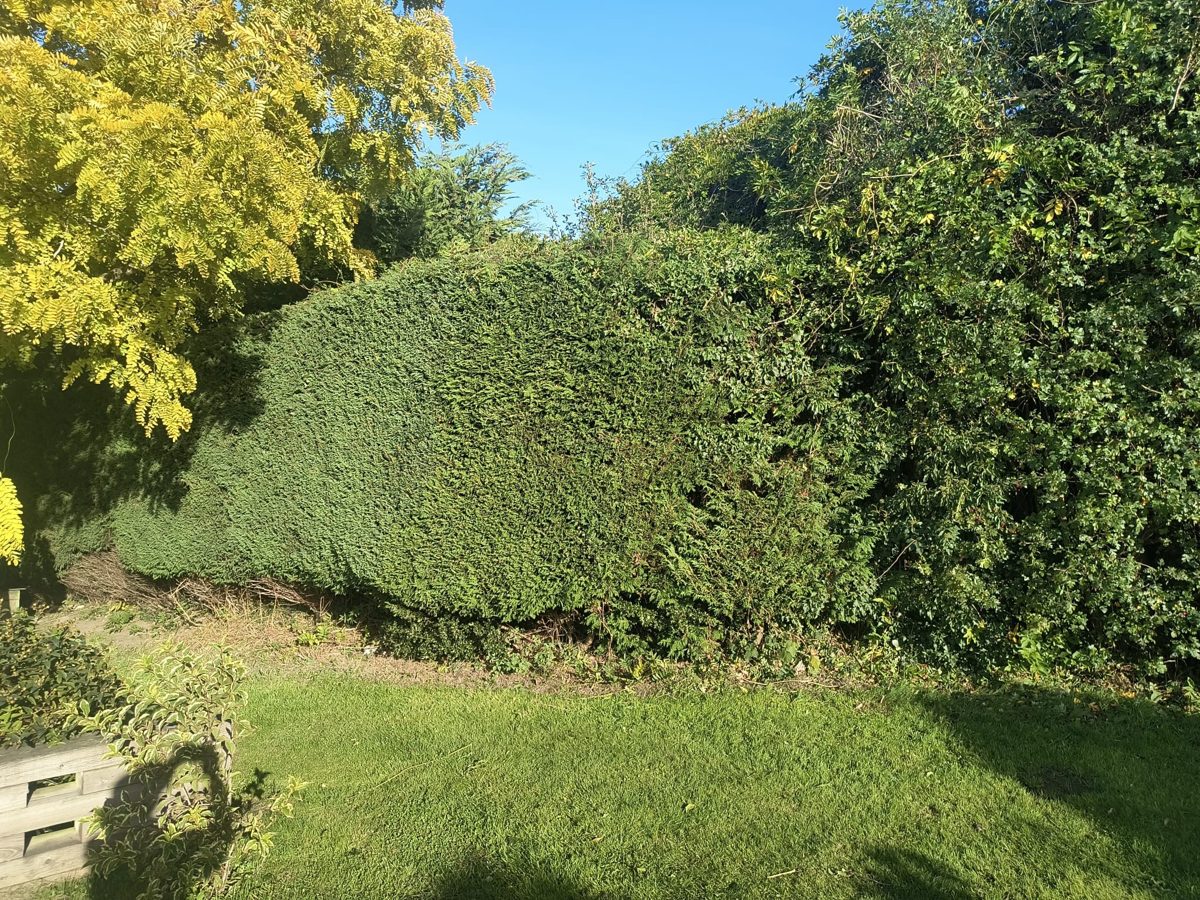
Some gardens are two hedges in one. This one, near Temple Ewell, had a leylandii run on one side that was easy to deal with, and a mix of climbers, laurel and self-seeded shrubs on the other that was not.
The picture
The photo shows the job in progress. On the left, the leylandii has been cut and shaped, with a clean, firm face and a tidy top. On the right, the older mixed boundary was still full of climber, with wisteria and honeysuckle-type growth pushing through a laurel and hawthorn hedge, and the top being carried away by it.
The order of work
We tackle a job like this from the structure outwards. The conifer is simplest, so it goes first, which gives us a clear line and room to work. Then the mixed boundary: climbers are cut out of the host hedge first, because trying to trim a hedge with a vine through it only makes a mess, and then the hedge itself is cut back to a sensible face.
Clippings are removed as we go so we are never working over a pile, and the ground is left clear at the end.
Chalk and wind
In the Dour valley the soil is thin and chalky, and the hedges on the slopes feel the wind. A hedge that has been cut hard and shaped properly will cope. One that has been left to go wild and then cut hard in a single go will not, so we plan the work in stages and we say so when that is the right answer.
What we promise
A proper job, or you do not pay. Pensioners get 5% off, and it is an honour system with no time limit. Repeat jobs over a certain size get 10% off.
Dover and the clifftop villages
We cover Dover, the Dour valley and the villages on the clifftops. Send us a photo of your hedge and we will give you a price.
Call 07763 100477 or email hello@doverhedges.co.uk for a quote.
Saw this on Facebook first? See the post
Dover Hedges.